· BolivianBlue · Travel · 4 min read
Traveling to Bolivia offers incredible experiences, from the stunning Uyuni Salt Flats to the high-altitude city of La Paz. However, managing your money in Bolivia can be tricky due to the country’s dual exchange rate system.
In this guide, we will explain everything you need to know about money in Bolivia in 2026, including the “Blue Dollar”, ATMs, and how to get the most out of your travel budget.
1. The Official vs. The Blue Dollar
Bolivia currently experiences a situation where the official exchange rate set by the government differs significantly from the parallel or “Blue Dollar” market rate.
- Official Rate: The government-pegged rate (historically around 6.96 BOB per USD). If you use a foreign credit card or withdraw from a standard ATM, your bank will convert your money at this official rate.
- Blue Dollar (Parallel) Rate: The actual market rate you can get when exchanging physical USD cash or using peer-to-peer crypto exchanges. This rate is often much higher than the official rate, meaning your money goes further.
Tip: You can check the live Blue Dollar rate on our BolivianBlue homepage.
2. Bringing Cash (USD)
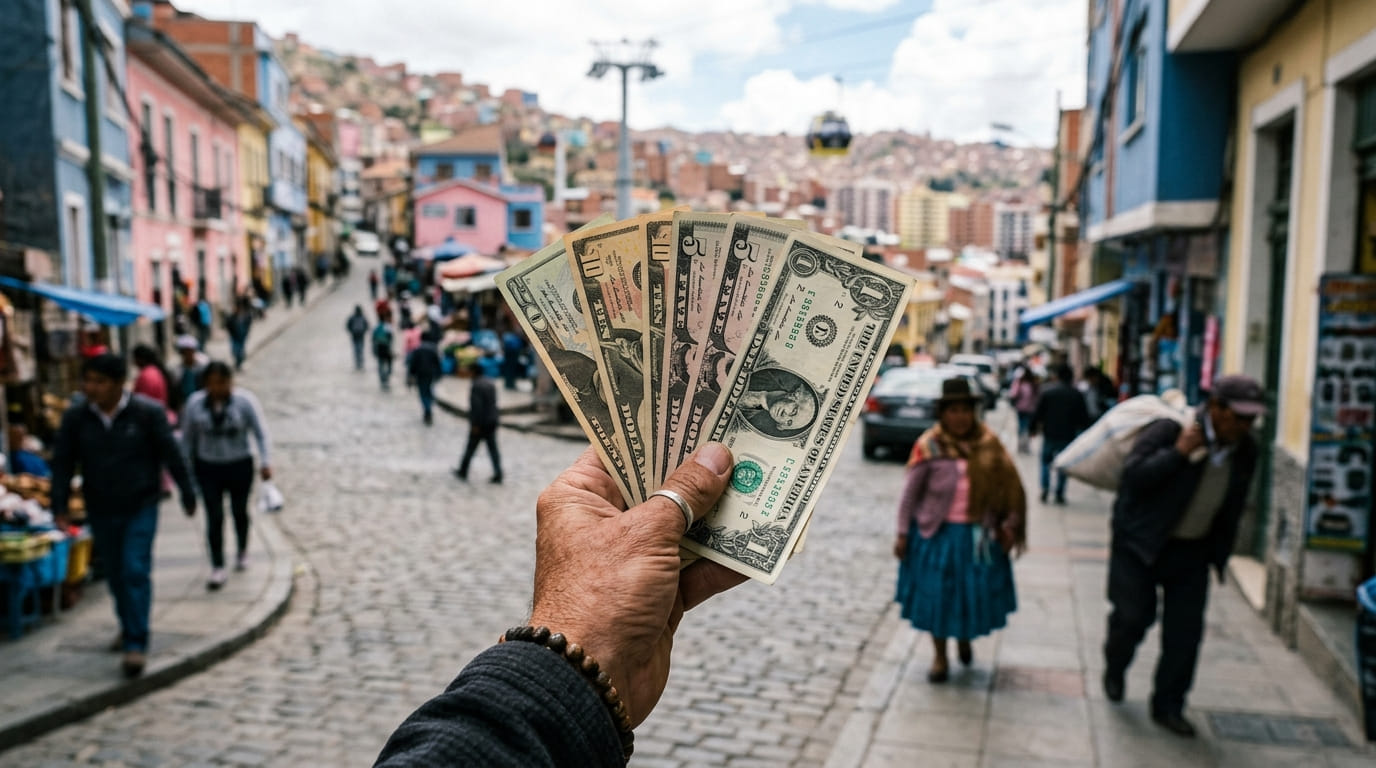
The absolute best way to get a good exchange rate in Bolivia is to bring physical US Dollars and exchange them at local exchange houses (Casas de Cambio) or on the informal market.
Important rules for USD cash:
- Bills must be in pristine condition. Exchange houses will reject bills with tears, writing, stamps, or even small folds.
- Bring $100 or $50 bills. Smaller denominations ($20, $10) are often exchanged at a lower rate.
- Newer series bills (blue strip) are preferred.
3. ATMs and Credit Cards
While major hotels, upscale restaurants, and large supermarkets accept credit cards, Bolivia is largely a cash-based society. You will need cash for markets, street food, small tours, and transport.
The Problem with ATMs: When you withdraw cash from a Bolivian ATM using a foreign card, you will receive Bolivianos (BOB) at the official exchange rate. Because the official rate is much lower than the Blue Dollar rate, you are effectively paying a premium for your trip. Furthermore, many Bolivian ATMs have low withdrawal limits and charge high withdrawal fees.
4. Alternative Ways to Get Cash at a Better Rate
If you don’t want to carry thousands of dollars in cash, there are alternative ways to access your money at a rate closer to the Blue Dollar:
Binance P2P (Crypto)
Many travelers and digital nomads use Binance P2P to buy USDT with their home bank account and then sell that USDT for Bolivianos. You can receive the Bolivianos via a local bank transfer or QR code (if you manage to open a basic account or use a friend’s account) or even arrange cash pickups.
Western Union
Western Union often offers an exchange rate that is better than the official bank rate, though not always as high as the street Blue Dollar rate. You can send money to yourself online from your home country and pick up physical Bolivianos at a Western Union branch in Bolivia.
Remitly
Remitly is another way to send money to yourself or family and pick up Bolivianos in cash, or receive a bank deposit. Rates are usually better than the official ATM rate, and first-time senders often get a promotional exchange rate.
5. Other Travel Essentials for Bolivia
Besides managing your money, make sure you have these essentials sorted before your trip:
Connectivity (eSIM)
Don’t rely on finding a physical SIM card right when you land. Get an eSIM before you arrive so you have data to check exchange rates and use maps.
- Holafly: Great for unlimited data options. Check out Holafly here.
Travel Insurance
Given the high altitude of places like La Paz (3,640m) and the adventurous nature of Bolivian tours (like the Death Road or Uyuni), travel insurance is a must.
- SafetyWing: Perfect for digital nomads and backpackers. Get a quote from SafetyWing.
Conclusion
To maximize your budget in Bolivia, bring pristine US Dollar bills to exchange at the parallel rate, or use tools like Binance P2P, Remitly, and Western Union. Relying solely on ATMs will mean you miss out on the better exchange rate. Keep an eye on the live rates here at BolivianBlue to stay informed during your trip!